
ECU Repair Malaysia — Fault-Code Check, ECU Specialist Workshops & Mail-In ECU Repair Nationwide
Short answer: ECU and vehicle-module repair in Malaysia is quoted in three bands — RM 180–500 for diagnostics, fault-code clearance and simple module resets, RM 500–1,500 for standard ECU, immobiliser, ABS or SRS repair on national and Japanese marques, and RM 1,500–5,000 for complex, European or coded module replacement. This is workshop work, not roadside. Holding a scanner code such as P0335, P1604, U0100 or B2799? Most check-engine codes are not ECU failures — check your code in the table below before you pay for any ECU work. The Platform does not set, hold, confirm, or arbitrate prices.
Engine ECU, immobiliser, ABS, airbag/SRS or TCM fault? Send your scanner result and photos on WhatsApp, or pick a specialist from the verified technician directory. The technician says whether it is really an ECU job, returns an indicative range and books a workshop slot before you drive or arrange towing. ECU workshops in Kuala Lumpur, Kota Warisan (Sepang) and Seremban 2 — and mail-in ECU repair from anywhere in Malaysia; mechanical engine repair sits outside this dispatch.
Got an OBD Fault Code? Check Whether It Really Points to the ECU
Short answer: most check-engine codes are not ECU failures. Codes such as P0335, P0171, P0011, P0300 and P0420 usually trace to a sensor, wiring, a vacuum leak, ignition or the exhaust — parts any competent mechanic can fix. The codes that genuinely point to an ECU or immobiliser specialist are internal control-module codes (P0601, P0604, P0605, P0606, P0607) and programming codes (P0602, P0630), lost-communication codes (U0100, U0101) once power and grounds test good, and immobiliser codes (B2795–B2799). Send a photo of your scanner screen on WhatsApp and an ECU technician on the platform tells you which group your code is in before you drive or tow the car anywhere.
| Code | What it means | Malaysian searches pair it with | Usually the ECU? | Check first |
|---|---|---|---|---|
| U0100 | Lost communication with the engine ECU (ECM/PCM “A”) | Myvi, Bezza, Alza, Proton | Sometimes — after power checks | Battery voltage, EFI fuse and main relay, ECU ground, connector corrosion, CAN wiring — then an ECU bench test |
| U0101 | Lost communication with the transmission control module (TCM) | Perodua, Proton, Honda | Sometimes — after power checks | TCM power, ground, connector and CAN wiring — then a TCM bench test |
| P0601 / P0604 / P0605 | ECU internal memory error (checksum, RAM or ROM) | Persona, Proton | Yes | Confirm stable battery and charging voltage, then ECU repair or reprogramming |
| P0606 / P0607 | ECU processor or performance fault | Proton, Honda, Toyota | Yes — after power and grounds test good | Power and ground circuits, then an ECU bench test |
| P0602 / P0630 | P0602: control-module programming error; P0630: VIN not programmed or mismatch in the ECU | Honda, Toyota; often after a used or replacement ECU | Often a programming, pairing or compatibility job — not proof the ECU itself has failed | ECU label, part number, hardware/software match and VIN compatibility; then write the VIN, pair, clone or program if required |
| B2795 / B2796 / B2798 | Immobiliser key codes — B2795: unmatched or unregistered key code; B2796: no communication between the key and the immobiliser ECU; B2798: communication error between the key and the immobiliser ECU | Toyota family (Corolla, Camry, Hilux, Lexus) | Immobiliser job | Try the spare key; key battery, transponder, antenna (coil) ring |
| B2799 | Engine immobiliser system malfunction — the engine ECU and the immobiliser ECU cannot communicate, the link wiring is faulty, or their communication IDs do not match | Toyota Hilux, Innova, Camry, Corolla | Immobiliser or ECU job | Companion immobiliser codes, ECU-to-immobiliser wiring and connectors, ECU ID registration / pairing |
| P1604 | Manufacturer-specific. Toyota definition: “Startability Malfunction” (cranked but did not start, or started and stalled); on a Perodua, go by the scanner description and the maker’s service information for the exact model, year and ECU | Axia, Bezza, Myvi, Alza, Hilux | Rarely | The other codes stored with it; battery and cranking, fuel, spark, security (key) light |
| P0335 | Crankshaft position sensor “A” circuit | Myvi, Alza, Viva, Saga BLM, Proton | Rarely | Crank sensor, its plug and wiring, reluctor ring |
| P0171 | System too lean, bank 1 | Aruz, Myvi, Bezza, Saga BLM, Persona, Exora | No | Vacuum or intake leak, airflow sensor, fuel pressure, A/F (O₂) sensor |
| P0011 | Intake camshaft timing over-advanced, bank 1 | Axia, Bezza, Viva, Alza, Exora | No | Engine oil level and condition, VVT oil-control valve, timing chain |
| P0300–P0304 | Random or single-cylinder misfire (P0301–P0304 name the cylinder; the 3-cylinder Axia and Bezza 1.0 can only set up to P0303) | Proton, Axia, Alza, Bezza, Persona | Rarely | Spark plugs, ignition coils, injectors, compression |
| P0420 | Catalytic converter efficiency below threshold, bank 1 | Toyota, Honda, Nissan | No | Exhaust leak, O₂ sensors, catalytic converter |
| P0700 | Transmission control system — the TCM has stored its own code | Honda City, Proton X70 | Read the TCM first | Scan the TCM for the underlying code; fluid level and condition |
Sources and limits: generic code names follow SAE J2012 (Diagnostic Trouble Code Definitions); P1604 and B2795–B2799 follow Toyota service-information definitions. Manufacturer-specific codes can vary by model, model year and ECU, so the description your scanner shows — and the maker’s service information — takes precedence. The “Malaysian searches pair it with” column records Google Malaysia autocomplete combinations observed on : it describes what drivers search for, not how often a fault occurs or how likely a diagnosis is. A code tells the technician where to start testing; it is not a diagnosis on its own.
Perodua Myvi, Axia, Bezza & Aruz: What the Codes Owners Search Actually Mean
P0335 on a Myvi
P0335 on a Perodua Myvi means the ECU is not receiving a usable signal from the crankshaft position sensor. Typical signs are long cranking, a no-start or stalling. It does not by itself mean the ECU is faulty: check the sensor, its plug and wiring first — a mechanic job. An ECU specialist is only needed if the sensor and wiring test good and the ECU still cannot read the signal.
Send my scanner photo →P1604 showing on an Axia or Bezza
P1604 is manufacturer-specific. Toyota service information defines it as “Startability Malfunction” — the engine was cranked but did not start, or started and then stalled — but that definition should not be assumed for every Perodua ECU. If an Axia or Bezza scanner shows P1604, go by the scanner’s description and Perodua’s service information for the exact model, year and ECU, and treat it as a no-start / start-stall triage clue until the maker’s definition is confirmed: read the companion codes and freeze-frame data, then check battery and cranking, fuel, spark and immobiliser status. If a B279x immobiliser code is stored alongside it, the immobiliser system needs diagnosis.
Send my scanner photo →U0100 on a Myvi or Bezza
U0100 means a control module has lost communication with the engine ECU (ECM/PCM). Which module logged it matters, so read the full vehicle scan rather than assuming it was the meter or the ABS unit. On a Myvi or Bezza that will not start with U0100 stored, check battery voltage, the EFI fuse and main relay, the ECU ground, the ECU connector for corrosion and the CAN wiring first. If power and wiring are proven good and the ECU still does not respond, that is when an ECU technician bench-tests or repairs the unit.
Send my scanner photo →B2799 and the flashing security light
B2799 is the Toyota-family code for “engine immobiliser system malfunction”. It is stored when the engine ECU and the immobiliser ECU cannot communicate, when the wiring between them is faulty, or when their communication IDs do not match; the result can be a no-start. It does not by itself prove the key is faulty. The technician checks the companion immobiliser codes, the wiring and connectors, and the ECU ID registration or pairing; a spare-key test helps when key-side codes or symptoms also point there. It often follows an ECU swap, a flood or electrical work.
Send my scanner photo →P0171 on an Aruz
P0171 means the engine is running lean on bank 1: it is getting more air or less fuel than the ECU expects. On an Aruz, Myvi or Bezza the usual causes are a vacuum or intake leak, a dirty airflow sensor, weak fuel delivery or an ageing A/F sensor. This is a mechanic job, not ECU repair — an ECU technician will tell you the same on WhatsApp.
Send my scanner photo →P0011 on an Axia
P0011 means the intake camshaft timing is more advanced than the ECU commanded. On an Axia, Bezza or Viva, low or old engine oil and a sticking VVT oil-control valve are the common causes; timing-chain wear is less common. Check the oil and the oil-control valve before anything else — it is not an ECU fault.
Send my scanner photo →ECU Repair at a Glance Who, where, what it costs
- Indicative cost: RM 180–500 diagnostics, fault-code clearance and simple module reset; RM 500–1,500 standard ECU, immobiliser, ABS or SRS repair on national and Japanese marques; RM 1,500–5,000 complex, European or coded module replacement. Indicative ranges compiled from MyLock dispatch quotations, Q3 2026, and the published MyLock price guide. Last updated . The Platform does not set, hold, confirm, or arbitrate prices.
- ECU workshops on the platform (business, base, shop hours):
- Flipkey Locksmith Security Services — Kuala Lumpur, From 9 AM, late-night shifts
- Chan Locksmith Sdn Bhd Sepang Branch — Sepang / Kota Warisan, 10 AM–10 PM
- How Locksmith — Seremban 2, Negeri Sembilan, 10 AM–10 PM
- Coverage: three workshop bases — Kuala Lumpur, Kota Warisan (Sepang) and Seremban 2 (Negeri Sembilan) — plus mail-in ECU repair from anywhere in Malaysia. Customers who need the car itself worked on drive or tow in — the specific workshop address and drive time are confirmed on WhatsApp before you set off or arrange towing.
- Method: you send fault codes and photos first; the technician confirms whether they can do your specific job, returns an indicative range and turnaround estimate, and schedules a workshop appointment before you drive or arrange towing. Diagnostic equipment does not travel.
Indicative ECU repair ranges — 3 bands
Quick answer: ECU repair in Malaysia is quoted in three indicative bands — RM 180–500 for diagnostic, light repair or a module reset; RM 500–1,500 for a standard engine ECU, immobiliser, ABS/SRS or TCM repair on a national or Japanese marque; and RM 1,500–5,000 for complex, European or coded-replacement work. You send fault codes and photos on WhatsApp first; an ECU technician on the platform confirms whether the job is feasible, returns an indicative range and turnaround estimate, and books a workshop appointment before you drive or arrange towing. The price is agreed directly between you and your technician on WhatsApp before the appointment is confirmed. The Platform does not set, hold, confirm, or arbitrate prices. For how ECU work compares with every other job we dispatch, see the 2026 locksmith price guide.
| Scope | Typical marque / module | Indicative range (RM) |
|---|---|---|
| Diagnostic + light repair / module reset | OBD scan, fault-code clearance, simple immobiliser reset, ABS bench repair (no programming) | RM 180 – RM 500 |
| Standard engine ECU / module repair | Perodua, Proton, Honda, Toyota, Mazda — bench repair with programming | RM 500 – RM 1,500 |
| Immobiliser / smart-key programming | National + Japanese — key learning, immobiliser programming | RM 500 – RM 1,500 |
| ABS / airbag-SRS / TCM repair | National + Japanese — bench repair or module exchange | RM 500 – RM 1,500 |
| Complex / European / replacement | BMW, Mercedes, Audi, VW, Ford — repair, full vehicle programming, or coded module replacement | RM 1,500 – RM 5,000 |
Indicative ranges only — the technician confirms after diagnosis on WhatsApp. The Platform does not set, hold, confirm, or arbitrate prices.
Proton Saga FLX “ECU 0042” — Fault Code or ECU Part Number?
Short answer: when Saga owners search “ECU 0042” they almost always mean the ECU itself, not a fault code. Proton ECUs carry a part number on the label — for example PW910042 or PW910041 — and sellers list used units by the last four digits. It is not the OBD code P0042, which is an oxygen-sensor heater circuit fault.
If you are buying a replacement Saga BLM or FLX ECU, match the full part number and the unit’s hardware and software details to your original ECU — not just the last four digits “0042”. A correctly matched, pre-coded unit may work without further programming; a used, unmatched or differently coded unit may need immobiliser or VIN pairing, cloning or programming. Confirm the exact unit with the seller and an ECU technician before you buy. Other Proton searches worth knowing: P0601 (ECU memory checksum error, searched with the Persona) is a genuine ECU job; P0171 and P0300 on a Saga, Persona or Exora are mechanic jobs first.
Send your ECU label photo →Mail-In ECU Repair from Anywhere in Malaysia — for Workshops and Car Owners
Short answer: you do not need to live near an ECU workshop. Most ECU jobs reach the platform’s ECU technicians as a module removed by the car’s own mechanic and sent by courier: the technician bench-tests and repairs the unit, then sends it back for refitting. It works from Johor Bahru, Ipoh, Penang, Kuantan, Kota Kinabalu, Kuching or anywhere else in Malaysia.
- WhatsApp first — send the scanner result, a photo of the ECU label (part number), the car’s model and year, and what has already been tested. The technician confirms whether the unit suits bench repair before anything is posted.
- Get the workshop address and packing instructions on WhatsApp — do not post a module before this.
- Remove and pack the ECU — disconnect the 12-volt battery before unplugging it, pack it in an anti-static bag with padding, and include a note with your name, WhatsApp number and car model.
- Send it with a tracked courier and share the tracking number on WhatsApp.
- Bench test, then the indicative range — the technician tests the unit and agrees the range and scope with you on WhatsApp before repairing it.
- Return and refit — the repaired unit is couriered back. Some vehicles need immobiliser pairing or programming after refitting; the technician tells you if yours does and how it can be done.
Courier costs and turnaround are agreed with the technician on WhatsApp. Jobs that need the car itself — key registration, on-car coding or wiring faults — still need a drive-in or tow-in visit. The Platform does not set, hold, confirm, or arbitrate prices.
Tanda ECU Rosak: Signs the ECU Itself Is Failing — Not Just a Sensor
Short answer: a genuinely failed ECU is less common than a failed sensor or wiring fault, and it usually shows up as a pattern rather than a single symptom. These are the signs that point to the ECU itself (tanda ECU rosak):
- Internal-fault codes stored — P0601, P0604, P0605, P0606 or P0607.
- The scanner cannot talk to the engine ECU (U0100) even after battery, fuses, main relay and grounds have tested good.
- Cranks with no spark or no injector pulse on any cylinder, with the crank sensor, fuses and wiring proven good.
- One cylinder’s coil or injector gets no drive signal while the part and its wiring test good — a failed ECU output driver.
- The car went dead after water reached the ECU, a jump-start mishap or an electrical short.
- The same fault returns straight away after the correct sensor was replaced and its wiring checked.
Hard starting, stalling, limp mode or a check-engine light on their own are not proof — sensors, fuel and ignition parts cause the same symptoms. That is why the technician asks for your scanner photo first.
When You Need an ECU Specialist — and When a Normal Mechanic Is Faster
Send it to an ECU or immobiliser specialist
- Internal control-module codes: P0601, P0604, P0605, P0606 and P0607.
- Programming codes P0602 and P0630, especially after a used or replacement ECU was fitted.
- U0100 / U0101 once battery, fuses, grounds and wiring test good.
- Immobiliser codes B2795–B2799 when the spare key also fails.
- An ECU that got wet in a flood, or stopped working after an electrical fault.
Start with a normal mechanic
- Sensor and circuit codes such as P0335 (crank) and P0340 (cam).
- Fuel-trim codes P0171 / P0174.
- VVT timing codes P0010–P0014.
- Misfire codes P0300–P0304.
- Catalyst and O₂ sensor codes such as P0420 and P0130–P0141.
If your code belongs in the second list, the ECU technician will say so on WhatsApp — you save a trip to a workshop you do not need, and the ECU stays in the car.
Car Won’t Start After a Battery Change (“Myvi tak boleh start lepas tukar bateri”)
Short answer: most no-starts after a battery change are not ECU faults. Check the simple causes first, in this order, and only treat it as an immobiliser or ECU job if the scanner and the security light point there.
- Terminals — both clamps tight and clean; a loose negative clamp is the most common cause.
- The battery itself — a new battery can still be the wrong size or undercharged; check voltage while cranking.
- Main fuses — a fusible link or EFI fuse can blow if the clamps touched the wrong post.
- The key — on push-start cars, a weak key-fob battery can prevent normal smart-key detection — follow the vehicle’s backup-start procedure if it has one (see car key battery replacement).
- Security light and scanner — if the key (security) indicator stays lit or keeps flashing after you switch on and the scanner shows a B279x immobiliser code, the immobiliser system needs diagnosis: send the scanner photo. P1604 on its own is not an immobiliser code — it is manufacturer-specific (Toyota defines it as a startability malfunction; go by your scanner’s description on a Perodua) and is read together with the other stored codes, cranking voltage, fuel, spark and immobiliser status.
Kereta Banjir ECU: What to Do with a Flood-Damaged ECU in the First Hour
Short answer: do not switch the car on. Powering a wet electronic module can short it instantly, and floodwater also causes corrosion and contamination even with the power off — so fast professional inspection gives the ECU the best chance of being cleaned or repaired.
- Do not turn the key or press start — not even to check the dashboard.
- Disconnect the 12-volt battery negative terminal only if the car is out of standing water and the battery is safe to reach. If the car is still in water, or it is a hybrid or EV with a high-voltage system, do not touch the electrics — arrange professional towing or recovery.
- Photograph the waterline inside and outside the car, and tell your insurer before any repair.
- Tow, do not drive, to the workshop.
- Send the photos on WhatsApp — the technician advises whether the ECU should be removed, cleaned and dried, or bench-tested first.
Corrosion keeps working after the water goes down, so a flooded ECU is time-sensitive. Malaysia’s northeast monsoon season usually runs from November to March, when these jobs peak.
Flooded car — send photos →Send Your Scanner Result for Technician Triage
- A photo of the scanner screen showing the code(s) and their descriptions — not just the code numbers.
- Model, year and engine — e.g. Myvi 1.3 2019 auto, Saga FLX 1.3 manual.
- What the car does — cranks or not, starts or not, which warning lights are on (a photo of the dashboard helps).
- What happened just before — battery change, jump-start, flood, workshop visit, used ECU fitted.
- Your area — so you are matched with the nearest of the three ECU workshops.
The hero aside above carries the full template — copy it, fill in your vehicle marque/model/year, symptom, fault codes if known, and the region you’d like the workshop matched in, then send to +60 17-273 9405 with photos attached. The assigned ECU technician replies with an indicative range and turnaround estimate before your workshop appointment is scheduled. The Platform does not set, hold, confirm, or arbitrate prices.
MyLock.my is a registered Malaysian business.
Technicians vetted for ECU/module work — engine ECU, immobiliser, ABS, SRS, TCM.
Fault codes and photos reviewed by an ECU technician on WhatsApp. Scope, indicative range, and appointment confirmed before you drive or arrange towing to the workshop.
Message MyLock central WhatsApp and we route you, or browse the technician directory and message a specialist directly. Same photo-quote flow either way.
Three ECU workshops; from anywhere else in Malaysia your mechanic can courier the removed module in.
What Needs Repair?
ECU and vehicle-electronics jobs are triaged into three diagnostic branches based on the symptoms, fault codes and the system most likely involved. Photos and codes narrow the branch before the appointment, because the diagnostic path and pricing band differ; workshop testing confirms which component, if any, has actually failed.
Branch A — Engine ECU / Powertrain
Engine ECU or transmission control module (TCM) fault suspected
Symptoms: limp mode, won’t start, intermittent stalling, persistent check-engine code, transmission shifting incorrectly. National and Japanese marques are typically bench-repairable with programming; European marques more often need module replacement with vehicle coding.
Scenario A1 — Internal ECU fault codes (P0601, P0604–P0607) or a dead injector / ignition output
Perodua, Proton, Honda, Toyota, Mazda. Once battery, grounds, wiring and the injector or coil itself have tested good, bench repair with programming is usually possible; Band 2 indicative range. Plain misfire codes (P0300–P0304) go to a mechanic first — see the fault-code table.
WhatsApp this scenario →Scenario A2 — European ECU limp mode or won’t start
BMW, Mercedes, Audi, VW, Ford. Bench repair where possible; otherwise coded module replacement. Band 3 indicative range — European marques typically need workshop bench work for repair or coded replacement.
WhatsApp this scenario →Scenario A3 — Transmission shifting incorrectly (TCM)
National and Japanese: TCM software repair is often possible without module replacement. European: more often requires module replacement with vehicle coding.
WhatsApp this scenario →Branch B — Immobiliser / Smart-key system
The car won’t start even though the battery, starter, and fuel are fine
The immobiliser or transponder system isn’t authorising the ECU to fire the engine. This is often confused with engine ECU failure — the diagnostic separates them. Many cases resolve with reset or key re-learning in Band 1 or low Band 2.
Scenario B1 — Lost or unrecognised key (key re-learning)
Replacement key not authorised by the immobiliser, or after-market key not paired. Key learning is often a single-session job once the technician has the right scanner and activation token for your marque.
WhatsApp this scenario →Scenario B2 — No-start or security fault after a battery change
Low voltage during or after a battery change can cause no-start symptoms or stored communication or security faults, but a normal battery replacement should not be assumed to erase key registration. Check battery voltage, terminals, grounds, the security light and the stored codes first; only if testing confirms an immobiliser fault should a reset, key re-learning or module repair be quoted. A confirmed reset typically sits in Band 1; a damaged immobiliser module escalates into Band 2.
WhatsApp this scenario →Scenario B3 — Combined engine ECU + immobiliser fault
Both modules report errors. The technician separates the symptoms after photos and a live scan. Combined cases typically sit in upper Band 2 for national/Japanese marques, Band 3 for European.
WhatsApp this scenario →Branch C — Other control modules (ABS · airbag/SRS)
An ABS or airbag/SRS warning light is on
The ABS unit (braking) and the airbag/SRS module (occupant restraint) are separate controllers from the engine ECU; transmission (TCM) faults sit with the powertrain in Branch A. On this page they sit on the same dispatch flow. ABS module work in particular has the widest price spread — from bench repair at Band 1 to European coded replacement at Band 3.
Scenario C1 — ABS warning light (bench repair or exchange)
National and Japanese: bench repair often possible at Band 1 floor; exchange unit in Band 2. Typical bench-repair workshop pricing — RM 180 for repair, around RM 280 for an exchange unit — anchors the bottom of this scenario’s range.
WhatsApp this scenario →Scenario C2 — Airbag / SRS module fault code
Persistent SRS warning often resolves with code clearance plus targeted repair; replacement is the fallback if the module is physically damaged. National/Japanese cases typically sit in Band 2.
WhatsApp this scenario →Scenario C3 — European ABS module (coded replacement)
BMW, Mercedes, Audi, VW, Ford ABS modules with coding requirements. Module replacement plus vehicle coding sits in Band 3 indicative range — the BMW-pattern RM 1,700–2,000 module-plus-programming case is a typical anchor inside this band.
WhatsApp this scenario →Not sure which branch fits? Send a photo of the warning lights and any scanner reading you have, and before any workshop appointment is scheduled the technician will identify the likely module branch and whether the case fits ECU or module work; the workshop diagnosis confirms the failed component. WhatsApp the photos →
Indicative Pricing — Three Bands
The bands below are indicative — final price is agreed directly between the customer and the assigned technician after photo diagnosis on WhatsApp. The Platform does not set, hold, confirm, or arbitrate prices.
Band 1
Diagnostic + light repair / module reset
RM 180 – RM 500 indicative
OBD diagnostic with fault-code clearance, ABS module bench repair without programming, simple immobiliser reset. National and Japanese marque cases where the module is recoverable without programming typically sit here.
Band 2
Standard ECU / module repair — national + Japanese
RM 500 – RM 1,500 indicative
Engine ECU bench repair with programming, immobiliser programming, ABS module exchange, key learning, TCM software repair. Perodua, Proton, Honda, Toyota, and Mazda cases typically sit here.
Band 3
Complex / European / replacement
RM 1,500 – RM 5,000 indicative
European-marque ECU repair or replacement, full vehicle programming, combined engine ECU + immobiliser, BMW/Mercedes/Audi/VW/Ford module replacement with coding. The Platform does not set, hold, confirm, or arbitrate prices — these are working ranges, finalised by the assigned technician after diagnosis.
What drives the range? Three mechanical factors, not policy. One: professional diagnostic equipment ranges from a few thousand ringgit to well above RM 10,000, and some coding functions carry paid subscriptions or per-vehicle activation — a diagnosis offered free is paid for somewhere else in the job. Two: automotive parts pricing in Malaysia shifts week to week — technicians on the platform have reported the same part moving from roughly RM 2,000 to RM 4,000 inside a single week on supplier-allocation moves — so any quote held beyond a short window puts the technician under-water on the job. Three: European-marque coding requires both the right tool and the right activation token for that specific vehicle, which is why Band 3 exists as a separate band rather than a continuation of Band 2. The Platform does not set, hold, confirm, or arbitrate prices. The technician on this platform quotes after diagnosis because the underlying cost basis genuinely moves; the indicative ranges above are honest about that uncertainty rather than disguising it.
Before You Confirm the Appointment — 2-Minute Checklist
Photo-quote arrived? Read this before saying “go”. The technician quotes after diagnosis and the indicative range is just that — indicative. Two minutes here gets you a better photo-quote and prevents the “wait, I didn’t agree to that” conversation later. The Platform does not set, hold, confirm, or arbitrate prices — the alignment happens between you and the technician on WhatsApp, and these are the points worth aligning on.
What the technician will typically ask
- Vehicle marque, model, year, and engine variant.
- The fault codes from your scanner (photo of the screen is fine).
- The warning light(s) currently showing on the cluster.
- What changed just before the fault — battery swap, workshop visit, flash flood, aftermarket alarm install.
- Where the car currently is (home / roadside / a workshop holding it).
- Whether the car can move under its own power or needs to be towed.
- Mileage on the odometer.
What YOU should confirm before saying “go”
- The indicative band you’ve been quoted, and which scope it covers (bench repair vs exchange vs replacement).
- Whether the quote includes vehicle programming / coding (Band 3 work typically does; Band 2 sometimes).
- Turnaround estimate from drop-off to collection.
- What happens if diagnosis reveals additional faults — does the quote escalate to a new band, or does the technician check back with you first.
- Workshop logistics (which workshop, what day/time to drive in, where to park, where to wait or how to collect).
- Which of the three workshops you are matched with, and whether the job is drive-in, tow-in or mail-in (see Areas Covered).
- Warranty terms on the specific work you’ve agreed (asked again at confirmation, not just on the marketing page).
Get it in writing
Anything the technician confirms on WhatsApp — the band, the turnaround, the warranty, the escalation rule — is in writing the moment it’s sent. WhatsApp messages are timestamped and stay searchable. If something changes during the work, the message thread is the reference, not anyone’s memory.
Why ECU Repair Doesn’t Require Separate Ownership Verification
ECU and module repair is workshop-based, but the vehicle does not have to be running. Bring every existing key you have; if the car cannot move under its own power, arrange towing to the assigned workshop. Having the vehicle and its existing keys at the workshop is what authorises ordinary ECU work — the technician repairs or re-pairs modules to keys you already hold and does not create new vehicle access. If the job turns into all-key-lost or vehicle-unlock work, MyLock’s separate ownership-verification protocol applies before any access or new-key work begins.
This is different from services where the technician creates access without your existing key:
- All-key-lost (AKL): Customer has no working key. Technician creates a new key paired to the immobilizer. Formal ownership verification required — IC plus live MyJPJ or MyDigital ID app on your own phone. See the all-key-lost service page for the full protocol.
- Vehicle unlock (customer has no working key — lost or inaccessible): Same logic — technician creates access without your existing key, so verification is required.
For ECU repair specifically, bring every existing key you have to the workshop appointment. Depending on the vehicle and the programming procedure, the technician may need one or all of your keys for registration or re-pairing — for example when an immobiliser module is replaced.
What this means for you: no ownership-document photos or ownership-verification app step for ordinary ECU and module repair — fault-code and module photos are still requested for technician triage. Drive or tow the car in with all your existing keys; the work is done at the workshop.
How Dispatch Works — from your photo to your finished module
Every ECU job routes through the same WhatsApp dispatch flow. Six steps from first message to job completion. The vehicle is brought to the assigned workshop with all existing keys — driven there if it can move, towed if it cannot. Ordinary ECU and module repair does not need MyLock’s separate ownership-verification step unless the job becomes all-key-lost or vehicle-unlock work.
You message us
WhatsApp +60 17-273 9405 with your vehicle marque, model, year, fault codes from the scanner if you have them, and what triggered the diagnosis (warning light, limp mode, no-start, etc.). Photos of the fault code reading and the module if visible speed up the assessment.
We capture scope & path
The assigned ECU technician reviews your photos and codes, identifies which module branch (engine ECU / immobiliser / ABS / SRS / TCM) the work involves, and which indicative band the job likely falls into.
Scheduled appointment by default: ECU diagnostic and repair is workshop-bound, not roadside. Equipment doesn’t travel.
Workshop assignment
Technician assigned. Workshop location is one of the three ECU workshop bases — Kuala Lumpur, Kota Warisan (Sepang) or Seremban 2 — depending on the module, technician availability and the equipment needed; for a mail-in job the technician sends the workshop address and packing instructions instead. The proposed appointment or drop-off timing is communicated to you on WhatsApp. You confirm timing that fits your schedule.
Indicative range agreed
Technician confirms scope, indicates band (1, 2, or 3), and agrees the indicative range with you on WhatsApp before the appointment. If photos reveal complexity (different module than first assumed, European programming, additional adapter required), the technician re-confirms the band before you drive or arrange towing. The Platform does not set, hold, confirm, or arbitrate prices.
Workshop appointment + on-bench work
You drive or tow the vehicle to the assigned technician’s workshop at the agreed time. Diagnostic with professional scanner, bench probing if needed, and repair / programming / replacement per the agreed scope.
If during work the technician finds the scope is materially different from the photo assessment, they pause and re-confirm pricing with you on WhatsApp before continuing. The Platform does not set, hold, confirm, or arbitrate prices — the indicative range agreed before dispatch is the working anchor.
Job done · Rating gate
A post-repair scan confirms the target fault has cleared and checks that the relevant code does not return; any unrelated stored codes are reported to you separately. You collect the vehicle at the workshop on the agreed completion day. Warranty terms restated in writing on WhatsApp. Payment record on request. The system follows up with a short rating prompt — your feedback shapes which technicians stay on the roster.
If no ECU technician is available for your workshop window — we say so on WhatsApp. We don’t promise dispatches we can’t fulfill. The Platform may attempt to contact another eligible technician if the first assigned technician’s schedule shifts. For services that DO require ownership verification (vehicle unlock, all-key-lost), see the all-key-lost service page.
Common Malaysian Vehicle-Electronics Scenarios
What this service actually looks like in Malaysian reality — the patterns that fill the WhatsApp inbox week after week. Most of these connect a familiar event (a flood, a battery swap, a workshop visit) to the module that probably needs attention next.
After a flash flood — waterline reached the bay
KL flash floods catch ECU modules sitting low in the engine bay or under a seat. Water ingress shows up as intermittent fault codes that get worse with humidity. Photos of the waterline, the dashboard codes, and where the module is mounted are the diagnosis-starter.
Battery died or was replaced — now the car will not start
A weak battery, a big voltage drop while cranking, a jump-start disturbance or a poor terminal or ground connection can cause no-start or communication symptoms. Do not assume the immobiliser has lost its registration after a normal battery replacement — check battery voltage, terminals, grounds, the security light and the stored codes before any reset, key learning or module work. Genuine immobiliser faults are Branch B territory and usually sit in Band 1 or low Band 2.
Limp mode after a long hot-afternoon drive
Heat-induced intermittent faults — usually a degraded connector or a temperature-sensitive sensor pulling the ECU into protection mode. The diagnosis is easier when the car is still warm; send photos before the codes self-clear.
Aftermarket alarm or remote-start install — and now nothing works right
Common Malaysian after-purchase customisation. Wiring spliced into the immobiliser loop or the ECU CAN bus can leave the system in a confused state long after the installer has gone. Untangling it is mostly diagnostic work — the modules themselves are usually fine.
Used / second-hand ECU bought from a yard — didn’t pair
A cost-saving move that fails often: the used module has a different VIN binding, different software version, or different immobiliser pairing. Either it can be reprogrammed to the vehicle, or it can’t — and the diagnostic tells you which before the next move.
ABS or SRS warning came on after a workshop visit and didn’t clear
Brake work, suspension work, or steering work can disturb the ABS or SRS modules’ wiring/sensors. The previous workshop cleared the codes but didn’t address the root cause; the warning came back the next drive. Branch C — typically bench-diagnosable.
When Replacement Becomes Necessary
Most ECU and module faults are repairable. National and Japanese engine ECUs, immobiliser modules, ABS modules, airbag/SRS modules, and TCMs are bench-repairable in the majority of cases the technicians see. That’s the honest first answer — and it’s why Band 1 and Band 2 cover the bulk of this dispatch.
But not always. A module that’s been through a flood with the connectors corroded through, a board with burnt traces from a wiring fault, a European module with proprietary firmware that can’t be touched outside the dealer’s diagnostic chain — these reach the limit of what bench repair can do, and the only honest path forward is replacement. Replacement also covers the European-marque scenarios in Branch A and Branch C where the supported workflow is “coded module replacement” — not because repair was tried and failed, but because the manufacturer’s electronic-service procedure is replacement-only for that module.
Saying so up-front is the point of this section. You shouldn’t discover at workshop-diagnosis stage that the technician has been quietly preparing you for replacement when the photo-quote suggested repair. If the diagnosis points to replacement, the technician says so — with the specific reason (corrosion / burnt traces / proprietary firmware / marque-specific procedure) and the band escalation it implies.
Customer consent is mandatory before any destructive method begins. Module replacement is covered under the same consent rule even though no physical destruction of the vehicle is involved — bench work is staged so the customer signs off on the replacement decision (and the revised band) before parts are ordered or installation begins. This is the line between “we’re investigating” and “we’re committing to replacement”; the WhatsApp message thread is where consent is recorded.
What a Proper ECU Diagnosis Should Check Before Anyone Replaces Your ECU
Short answer: an ECU should be condemned only after its power, grounds, wiring and inputs have been proven good. A replacement quote that arrives before those tests is a guess.
- Battery and charging voltage — low or unstable voltage produces false ECU and communication codes.
- Fuses, main relay and grounds — the ECU cannot talk if its supply or ground is missing.
- Connectors and wiring — corrosion, water or a chafed CAN line mimic a dead ECU.
- Sensors and outputs — the component the code names (crank sensor, coil, injector) is tested before the ECU that reads it.
- Bench test of the ECU — only then is the unit itself tested, repaired or reprogrammed.
Three questions to ask before you approve ECU work
- Which tests were done on power, grounds and wiring, and what were the readings?
- Was a bench repair attempted, and if not, why not (corrosion, burnt traces, proprietary firmware)?
- What warranty applies to the repair, and is it written in the WhatsApp thread?
Photo-quote-first scheduling supports all three: the indicative range is set on WhatsApp before the car arrives, any extra fault found during diagnosis is messaged to you before work continues, and the warranty terms sit in a thread you can scroll back through. The Platform does not set, hold, confirm, or arbitrate prices.
BM · 中文
This Page in Bahasa Melayu and Chinese
The same fault-code guide, workshops and indicative ranges are published in full in two more languages:
Related Locksmith Services
Smart Key Programming
When a replacement key won’t pair to your vehicle, the immobiliser is doing the work. Smart-key programming is the focused sibling to broad ECU repair — same immobiliser pathway, narrower scope.
All Key Lost
If every key to a vehicle is gone, restoring access needs immobiliser programming alongside new key creation. Same ECU-side touchpoint as immobiliser repair on this page, packaged as a key-recovery dispatch.
Car Key Duplication Malaysia
Mechanical and transponder key duplication for Malaysian vehicles. Where ECU work touches the immobiliser electronics, key duplication covers the mechanical-plus-transponder side of the same key.
ECU Workshops That Take ECU and Immobiliser Module Work
ECU board and immobiliser-module work is workshop-based — the car comes to the technician, or the module is removed and brought in. Three platform-verified ECU workshops take this work — Flipkey Locksmith Security Services, Chan Locksmith and How Locksmith; Flipkey and Chan also hold a GPPKM affiliation. Hours are their own shop hours, and all three accept couriered ECU modules from outside their area.
| Technician | Base | ECU work listed | Shop hours |
|---|---|---|---|
| Flipkey Locksmith Security Services | Kuala Lumpur | ECU diagnosis, ECU reflash, ECU board repair, immobiliser error-code fix | From 9 AM, late-night shifts |
| Chan Locksmith Sdn Bhd Sepang Branch | Sepang / Kota Warisan | ECU diagnosis, ECU reflash, ECU board repair, immobiliser error-code fix | 10 AM–10 PM |
| How Locksmith | Seremban 2, Negeri Sembilan | ECU diagnosis, ECU reflash, ECU board repair, immobiliser error-code fix | 10 AM–10 PM |
Immobiliser faults that turn out to be key-side (chip, transponder ring, remote) are handled by the wider automotive roster — see immobiliser repair and smart key programming.
Areas Covered: Three ECU Workshops plus Mail-In from Anywhere in Malaysia
ECU work happens at three workshop bases: Kuala Lumpur (Flipkey), Kota Warisan, Sepang (Chan Locksmith) and Seremban 2, Negeri Sembilan (How Locksmith). Anywhere else in Malaysia — Johor Bahru, Ipoh, Penang, the East Coast, Sabah or Sarawak — the ECU module can be removed by your own mechanic and couriered in; jobs that need the car itself are driven or towed to the nearest of the three. The specific workshop address is confirmed on WhatsApp in the photo-quote step.
Klang Valley
You are matched with whichever workshop is nearest and has the right skill for your module — central Kuala Lumpur to the KL workshop; Putrajaya, Cyberjaya and the KLIA side to Kota Warisan. The technician confirms the address and drive time before you set off or arrange towing.
Negeri Sembilan and the rest of Malaysia
How Locksmith in Seremban 2 takes drive-in and tow-in ECU work from Seremban, Senawang, Nilai, Mantin and Port Dickson. From Johor, Perak, Penang, the East Coast, Sabah or Sarawak, ECU jobs are usually handled by mail-in: your mechanic removes the module and couriers it to the assigned workshop, and the repaired unit is sent back for refitting.
Workshop availability per town varies by which ECU specialists are currently active in the network and what scope of work your job needs. The technician confirms the exact workshop address and an estimated drive time in the photo-quote on WhatsApp before you commit to the appointment. There is no MyLock-side travel charge in the workshop-visit model — you drive to the assigned workshop at the agreed appointment time.
Frequently Asked Questions
How fast can a technician be arranged?
Indicative range and turnaround estimate are returned by the assigned ECU technician on WhatsApp once they have reviewed your photos and fault codes. Workshop appointment timing depends on the technician’s availability and the scope of the work — straightforward Band 1 cases typically book sooner; complex Band 3 work may need to coordinate with parts lead time. If the first-choice technician is unavailable, the Platform may attempt to contact another eligible technician.
Harga repair ECU kereta: how much does ECU repair cost in Malaysia?
Indicative ranges are RM 180–500 (Band 1 diagnostic + light repair / module reset), RM 500–1,500 (Band 2 standard ECU/module repair for national and Japanese marques), and RM 1,500–5,000 (Band 3 complex / European / coded replacement). Final price is agreed directly with the technician on WhatsApp after photo diagnosis. The Platform does not set, hold, confirm, or arbitrate prices. See the pricing card grid above for what each band covers.
Are your technicians verified?
MyLock.my is SSM-registered. Flipkey Locksmith Security Services (Kuala Lumpur), Chan Locksmith (Kota Warisan, Sepang) and How Locksmith (Seremban 2) are platform-verified for ECU and module work.
Do I need to prove vehicle ownership for ECU repair?
No formal ownership verification is required for ordinary ECU and module repair. You drive or tow the vehicle to the workshop and bring every existing key — having the car and its keys at the workshop is the practical ownership demonstration, even if the car currently will not start. This is different from all-key-lost or vehicle unlock services, where the technician creates vehicle access without your existing key and formal verification (IC plus live MyJPJ or MyDigital ID app) is mandatory. For ECU repair, bring every existing key you have to the workshop so any required programming or module pairing can be done with the keys already in your possession. Full verification protocol for services that DO require it is documented at the all-key-lost service page.
Why can’t I be quoted a fixed price upfront?
Because the underlying cost basis genuinely moves. Professional diagnostic equipment ranges from a few thousand ringgit to well above RM 10,000, and some coding functions carry paid subscriptions or per-vehicle activation; parts pricing in Malaysia shifts week to week on supplier-allocation moves; European-marque coding requires the right activation token for that specific vehicle. A fixed phone-price quote before the module is seen would either guess (and be wrong) or absorb the variance as a hidden surcharge. The photo-quoted indicative range is the honest version of the answer; the final price is confirmed after diagnosis.
Why doesn’t MyLock offer free diagnosis like some workshops?
A code read is free on many basic scanners, but a diagnosis is more than a code read: it means testing power, grounds, wiring and the component the code names, often with equipment costing from a few thousand ringgit to well above RM 10,000. Technicians on this platform quote that work openly instead of recovering it later in the repair. What you can get for free is triage — send your scanner photo on WhatsApp and the technician tells you whether the code is likely an ECU job at all.
Does a check-engine light mean my ECU is faulty?
Usually not. The check-engine light means the ECU has detected a fault somewhere — most often a sensor, wiring, vacuum, ignition or exhaust problem. ECU hardware faults, programming issues and communication faults leave different code patterns: internal ECU faults include P0601 and P0604–P0607; P0630 is a VIN-programming or mismatch code; U0100 is a communication-loss code that needs power, ground and wiring checks before anyone blames the ECU. A steady light means get it checked soon; a flashing light means a severe misfire — stop driving to protect the catalytic converter. See the fault-code table.
Can I plug in a used ECU from Shopee or a scrapyard?
Sometimes. A correctly matched, pre-coded unit may work straight away, but a used or unmatched ECU often needs immobiliser or VIN pairing, cloning or programming before the engine will run — and on some vehicles it sets P0630 (VIN not programmed). Match the full part number and hardware/software details on the label, and plan any pairing with an ECU technician before you buy.
What kind of diagnostic equipment do MyLock technicians use?
Professional-grade diagnostic scanners. The brands commonly used by ECU technicians on this platform include Autel MaxiSYS, Autel MaxiCOM, Launch, Thinkcar and Autoland. Cost varies widely: depending on the model, adapters, subscriptions and coding capability, workshop systems range from a few thousand ringgit to well above RM 10,000, and some programming functions also need paid software, subscriptions or per-vehicle activation — which is why technicians quote after diagnosis rather than offering free scans.
How will I know which module is actually failing?
Photos and fault codes narrow the likely branch before the appointment — the engine ECU branch (Branch A), the immobiliser / smart-key branch (Branch B) or the other-control-module branch (Branch C: ABS, airbag/SRS; TCM faults sit in Branch A) — but they do not by themselves prove which module has failed. At the workshop the technician combines a live scan with power, ground, wiring and component tests, and bench testing where needed, before deciding whether an ECU, immobiliser, ABS/SRS or TCM module is actually faulty.
What if I am outside Kuala Lumpur and Selangor?
Use mail-in. Most ECU jobs from outside the Klang Valley and Negeri Sembilan arrive as a module removed by the customer’s own mechanic and sent by courier to Flipkey (Kuala Lumpur), Chan Locksmith (Kota Warisan) or How Locksmith (Seremban 2); the repaired unit is couriered back for refitting. Jobs that need the car itself — such as key registration or on-car coding — are driven or towed in. Straightforward Band 1 work often completes within a day of the unit arriving; complex Band 3 work may take longer and require parts ordering.
What warranty terms apply?
Warranty terms are agreed by the assigned technician on WhatsApp at appointment confirmation, restated when the work completes, and vary by scope: bench repair, exchange unit, programming, and coded replacement carry different warranty windows. Get the terms in writing on the WhatsApp message thread — the thread is the warranty record (see the “Get it in writing” callout in the Before You Confirm the Appointment section above).
What’s the difference between messaging MyLock and messaging a technician directly?
Two paths, same outcome. Path A — message MyLock central WhatsApp at +60 17-273 9405 and we route you to an ECU technician based on your symptom, vehicle and area. Path B — browse the verified technician directory and message a specialist directly, useful if you already have a workshop or specialist in mind, or want to compare two technicians before deciding. Either way the photo-quote-first scheduling flow is the same — fault codes and photos first, indicative range and appointment second, workshop attendance third.
Got an ECU, immobiliser, ABS, SRS, or TCM module fault?
Send fault codes and photos on WhatsApp. An ECU technician on the platform returns an indicative range and turnaround estimate before any workshop appointment is scheduled. If the first-choice technician is unavailable, the Platform may attempt to contact another eligible technician.
Indicative pricing is for guidance only — final price is agreed directly with the technician after diagnosis. The Platform does not set, hold, confirm, or arbitrate prices.
Reviewed for accuracy by Vince Tan, founder MyLock.my · Last updated
About MyLock.my: MyLock.my is an SSM-registered Malaysian platform that connects vehicle owners with independent technicians for ECU and vehicle-electronics repair. The platform routes customers to the appropriate specialist via WhatsApp at +60 17-273 9405 and through the technician directory at /technician/; the technician then quotes, schedules, and performs the work at their own workshop.
Vehicle marque and model references in this page — Perodua (Myvi, Axia, Bezza, Alza, Aruz, Viva), Proton (Saga, Persona, Exora, X70), Honda, Toyota, Mazda, BMW, Mercedes-Benz, Audi, Volkswagen, and Ford — are used solely to describe the scope of typical repair scenarios. No representation of authorisation, endorsement, partnership, or affiliation with any vehicle manufacturer is made.
Diagnostic equipment brand references in this page — Autel MaxiSYS, Autel MaxiCOM, Launch, Thinkcar, and Autoland — are used solely to describe the type of professional diagnostic tools commonly used by ECU technicians on this platform. No representation of authorisation, endorsement, partnership, or affiliation with any equipment manufacturer is made.
Recent ECU Jobs by Our Verified Technicians
Real ECU diagnosis and board-level repair jobs by MyLock-verified technicians. Each photo is credited to the technician who did the work.
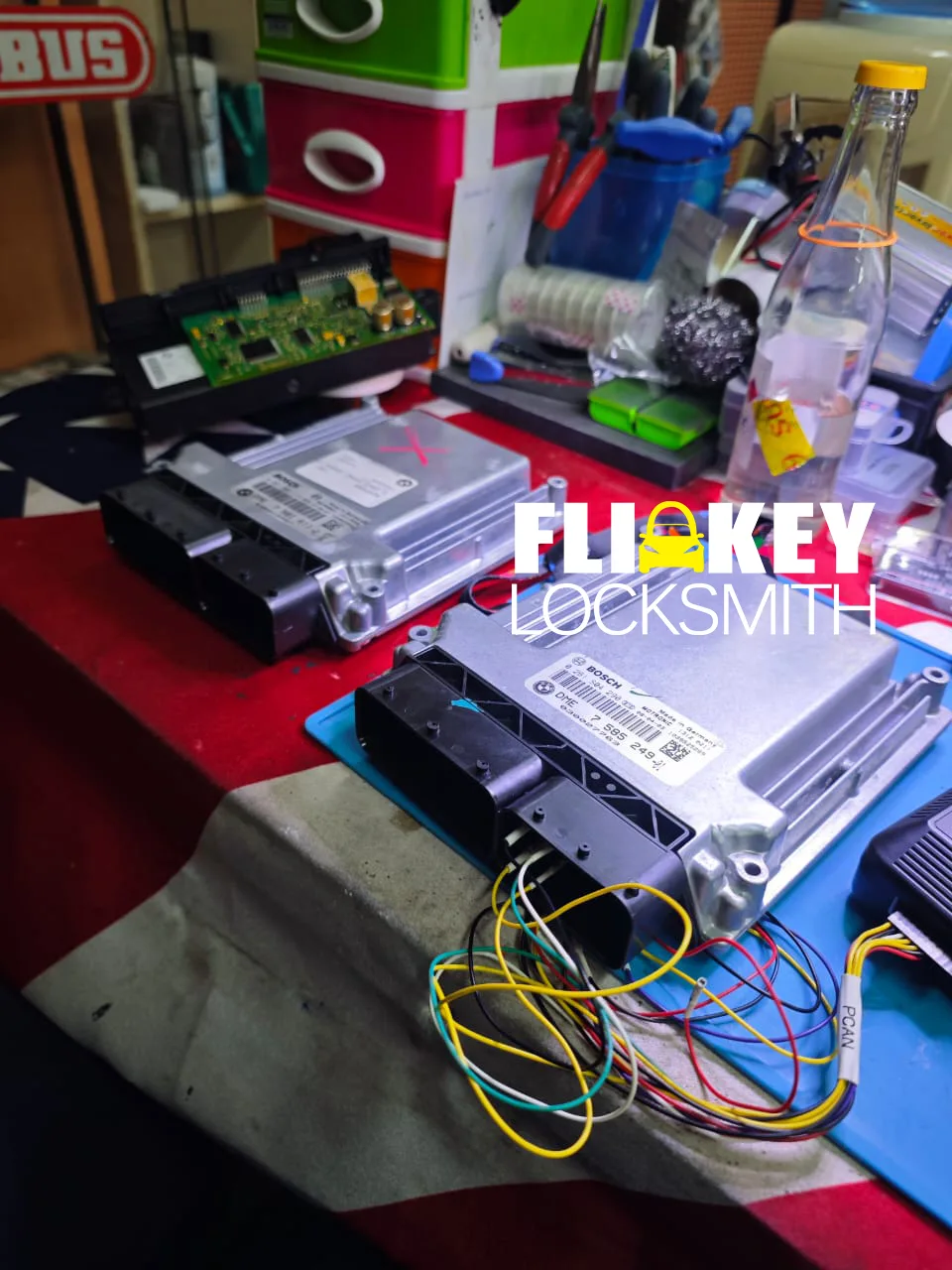


Photos shared by our verified technicians, used with their permission. The Platform connects you with the technician; scope and final price are agreed directly with the technician before any work.