
Key Fob Repair Workshop in Malaysia — Your Entry Door to the Automotive Trade
A hands-on, bench-based trade-skill workshop that teaches you to diagnose and repair car key fobs — dead remotes, water and drop damage, worn buttons, and chip-level faults — across VW, Audi, BMW, Mercedes and domestic brands. It is the lowest-cost entry point into MyLock’s automotive-electronics pathway, and the natural first step before car key programming and ECU work.
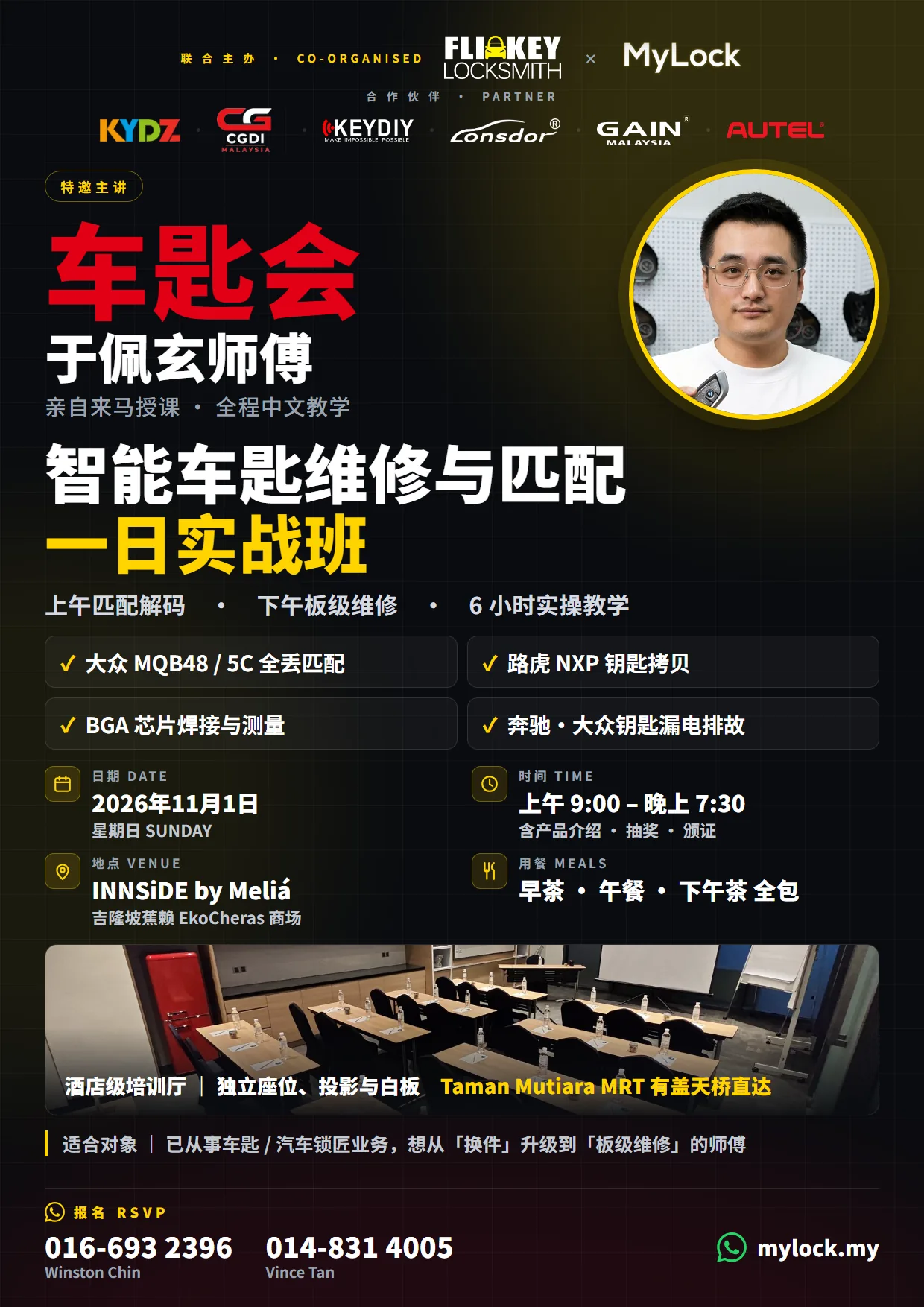
Smart Key Repair & Programming — a dated one-day class
The afternoon half of the one-day class on Sunday 1 November 2026 is board-level fob work at exactly this bench: multimeter testing, BGA chip removal and reballing, and real Mercedes-Benz and Volkswagen key current-drain cases.
It runs 9:00 am to 7:30 pm on Sunday, 1 November 2026 at INNSiDE by Meliá Kuala Lumpur Cheras, co-organised by MyLock and Flipkey Locksmith, at RM950 per person including an RM180 electronic test instrument you keep. Guest instructor: Sifu Yu Pei Xuan (于佩玄) of 车匙会. The class is the paid half of Car Key Tech Day 2026; a free brand showcase floor runs the same day at the same venue.
Who This Workshop Is For
Key fob repair is the gentlest entry into the automotive-electronics trade because it builds genuine electronics skill without first needing an expensive programmer. It suits:
- Complete beginners who want a low-cost, low-risk way to test whether the automotive trade is for them before committing to a full programming setup.
- Mechanical locksmiths already cutting and duplicating keys who want to add an electronics service line and stop turning fob-repair jobs away.
- Phone & small-electronics repairers with soldering experience who want a higher-margin niche — key fobs reuse skills you already have.
- Aspiring MyLock technicians who want a documented starting point on the path toward dispatch-roster eligibility.
No prior automotive experience is required. If you have used a multimeter before, you already have a head start.
What You’ll Learn
The workshop is hands-on from the first hour — you work on real key boards at a repair bench, not slides. The scope moves from electronics fundamentals to brand-specific common faults.
Electronics Fundamentals
Identifying electronic components and their function, taking measurements, and confident use of the multimeter — the bedrock skills every key repair depends on.
Key PCB Diagnostics
The functional layout of a key board, a repeatable repair methodology, quickly locating power rails, and reading faults from current draw with an ammeter.
Chip-Level Work
Chip pinout definitions, measuring and decapping chips, and BGA chip soldering — the bench techniques that separate a parts-swapper from a real repairer.
Brand Common Faults
The recurring fob failures on VW, Audi, BMW, Mercedes and domestic brands — plus upgrading or refitting an older key to a newer style, with tips and cautions.
Intake Methodology
A disciplined Listen · Ask · Observe intake routine before you touch a key — so you diagnose deliberately instead of blindly disassembling and doubling your time.
When to Re-Match
Recognising when a repaired key also needs re-programming to the immobiliser — the hand-off point into the Car Key Programming specialty.
The Tools You’ll Work With
One advantage of starting here: a fob-repair bench is the cheapest setup in the trade. You learn on workshop equipment; when you set up your own bench, the core kit is a quality soldering station, a multimeter, an ammeter, a hot-air rework station for chip work, and a microscope or loupe. You do not need a programmer to start repairing fobs — that investment comes later if you progress to programming.
For reference, the programming tools used in the later specialties are sold in Malaysia in these approximate ranges (you buy your own; the workshop does not bundle hardware):
| Tool family | Typical use | Approx. MY range |
|---|---|---|
| KEYDIY (KD-X2, KD MAX) | Remote generation, entry programming | RM 799 – 2,499 |
| CGDI (CG100, CG Pro) | Airbag/EEPROM & chip work | RM 1,200 – 4,500 |
| Autel (IM508S, IM608 Pro) | Diagnostics & programming | RM 6,000 – 15,000 |
| Xhorse VVDI family | Identify · program · generate · copy | RM 7,999 – 14,900 |
Ranges are platform observations of Malaysian distributor pricing and change over time — confirm current pricing with the distributor before buying.
From Enquiry to the Dispatch Pathway
A simple, honest sequence — no academy theatre, just bench time and a real route to dispatch eligibility.
Enquire & choose a format
WhatsApp us for the brochure. We help you pick Group, Small-group or 1-on-1 based on your experience and pace.
Bench practice
You work on real key boards from day one — diagnosing, soldering, and repairing under a trainer’s guidance.
Brand fault drills
You practise the recurring VW, Audi, BMW, Mercedes and domestic-brand fob faults until the routine is muscle memory.
Self-directed practice
After the workshop you practise on your own bench — the graduates who become competent fastest treat the workshop as a starting line.
Dispatch-pathway briefing
We explain the seven-step MyLock dispatch pathway — how qualified technicians become eligible for real customer jobs.
Progress to programming
When you’re ready, step up to Car Key Programming or ECU & Immobiliser Repair.
Workshop Formats
Three delivery formats are available across the automotive-electronics cluster. Pricing is set per format and discussed on enquiry — it is not published on the page.
- Group Workshop — scheduled cohort intake with peer learning; the most accessible tier.
- Small-Group Workshop — 2–4 trainees, higher trainer attention, scope you can steer toward specific brands.
- One-on-One Workshop — bespoke and fastest; best for trade-experienced applicants.
Full format details live on the Car Key Programming Course Malaysia hub.
Explore the Automotive-Electronics Cluster
Car Key Programming Course Malaysia →
The specialty hub: overview, format tiers, and how the three workshops fit together.
Car Key Programming →
The core trade: immobiliser, transponder and key matching across VAG, BMW, Mercedes and domestic makes.
ECU & Immobiliser Repair →
Advanced bench work: ECU, BMW BDC, VAG data and immobiliser-data repair.
All MyLock Workshops →
The full training pillar: six tracks, income reality, and the seven-step dispatch pathway.
Common Questions
Do I need any experience to join the Key Fob Repair Workshop?
No. It is beginner-friendly and starts from electronics fundamentals — identifying components, taking measurements, and using a multimeter. Prior soldering or multimeter experience helps you move faster, but it is not required. This is the gentlest entry point into the automotive-electronics trade.
Is this a key programming course?
No — this workshop teaches fob repair (the hardware: boards, chips, buttons, water and drop damage). Matching or programming a key to a car’s immobiliser is a separate specialty covered in our Car Key Programming workshop. Many technicians start with repair and progress to programming once their electronics skills are solid.
What tools do I need to buy?
To start repairing fobs you need a quality soldering station, a multimeter, an ammeter, a hot-air rework station and a microscope or loupe — a comparatively low-cost bench. You do not need an expensive programmer for repair work; that investment only applies if you later move into programming. You learn on workshop equipment during the course and buy your own kit afterward.
Will this workshop get me onto the MyLock dispatch roster?
It is a documented first step, not an automatic placement. The workshop builds the foundation skill and briefs you on the seven-step MyLock dispatch pathway. Roster eligibility depends on demonstrated competence and available roster capacity, and completing a workshop does not guarantee earnings or dispatch volume.
How much does the workshop cost?
The next dated cohort — the one-day Smart Key Repair & Programming class on Sunday 1 November 2026, whose afternoon session is board-level fob work — is RM950 per person, including an RM180 electronic test instrument you keep. Note that it assumes you already work on car keys; the ongoing beginner-friendly formats of this workshop are quoted on enquiry.
Start at the Bench — Where the Trade Really Begins
Get the brochure, current schedule, and the tool list. Prefer to talk through the training in detail first? Message our training team directly — both lines reach us.
About this training: MyLock workshops are practical trade-skill workshops connected to the MyLock dispatch network. They are not MOE-registered programmes, not SKM-certified, and not HRD Corp claimable. We use “workshop” and “trade-skill training” deliberately — no diploma, certificate, or accreditation is implied or awarded.
Income and dispatch outcomes are not guaranteed. Earnings depend on individual effort, skill development over time, and market demand. Figures or pathways described are operating context, not promises.